One planet, one pulse: Lessons in healthy human dialogue from Doha Debates









PUBLISHED:
October 08, 2026
WRITTEN BY:

Making magic in the Majlis
Reflections is a monthly blog series featuring Doha Debates community members—including ambassadors, young debaters and guest experts—sharing their unique perspectives on debate, critical thinking and the power of cross-cultural connection.
In this post, graduate student Sarah M. Abraham writes about her experiences as a mentor in the Doha Debates Ambassador Program.
I’ve been a mentor for three cohorts of the Doha Debates Ambassador Program, and the process is equally unpredictable every time I do it. But I’ve found that unpredictability is the key to making magic.
Beginning to mentor a new group of ambassadors is a lot like teaching your friends a new game: Everyone’s too excited from the high of finally being in the room together to listen to the “rules,” especially if they’re too long-winded or detailed. They’re eager to get started, and if I try to define perfectly what our end goal is, I may just lose them. So instead, I’ve learned to jump in directly.
My most recent cohort really helped me hone this approach. They made me realize that explaining the rules of working together can sometimes be less helpful than simply inviting honest storytelling, which can build trust faster than any formal guidelines.

We started by sharing honestly.
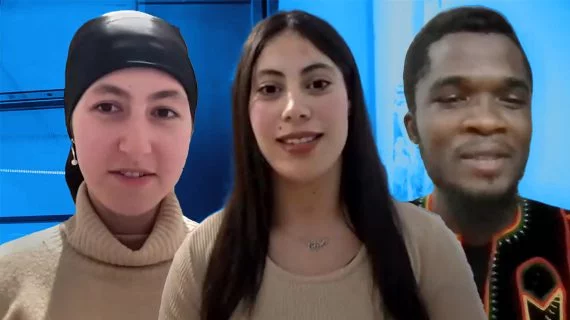
The ambassador program is fully online, conducted through individual study and reflection posts sandwiched between weekly Zoom meetings. Over the course of 12 weeks, ambassadors learn cross-cultural communication, systems thinking and debate skills, led by experts and a group of mentors (including myself) who have already gone through the program.
This time around, my team consisted of six mentees from all over the world: Ecuador, Hong Kong, Argentina, Somalia and Qatar. (I myself am from India.) Across time zones and screens, with faith and imagination alone, we started our intrepid exploration of Majlis-style debate.
The program begins with several activities that help set the tone for their work together, one of which is the development of agreements. Each team is asked to come up with norms that everyone should follow in order to successfully learn and work as a group.
Without ever collectively deciding to, my group responded to this prompt by sharing personal stories. By talking about their lived experiences honestly and authentically, and holding space for their teammates to share, they uncovered the agreements that worked for them.
Mohammad shared that being bullied while in school made him feel like his voice and opinions “did not matter enough to be expressed.” His story made it clear to the group that not everyone comes to a dialogue as equals, complicating our ideas about safe spaces and requiring reflection on how to make each other feel truly welcome. As a result, we decided that our cameras would stay on only if we had the bandwidth, that speakers should be aware of the amount of time they took to speak, and that everyone should be aware of who had not had a chance to contribute.
Meanwhile, May shared a story of fleeing conflict in Somalia and living as a refugee in Kenya and Uganda, saying, “different people carry different struggles that are not always visible.” This, in turn, helped Mmesoma to share about the passing of her father in 2024. Both their stories revealed there was a lot of loss and sorrow here, so we needed to move with empathy.
Each story helped the team set an early tone of warm curiosity and genuine care. This, in turn, laid the foundation for trust, and helped everyone see how they could learn from each other through (and be rewarded by) honesty.
We asked difficult questions.
Following a break for Ramadan, the group came back still bonded from sharing their personal stories. It was time to engage in a systems mapping activity, which reveals how every part of a complex global issue—people, places, policies, ideas, etc.—is interconnected. This, in turn, would help us understand how the whole system functions, and where meaningful change might happen.
I decided to ask them to map how boys are being educated (and failed), since the topic had come up organically through our shared discussions.
The group again used personal experiences to guide them, this time as a lens through which they investigated the elements that create the conditions leading to young men’s anger, conservativism and/or violence.

May reflected on his own household: After his parents’ divorce, he and his brothers decided they had to help their sister, who was doing all of the housework. “That’s when we realized, as boys, how much women do for us and how much we take them for granted,” he observed. May’s reflection highlighted the care and labor gap. What would the world look like if all people, not just girls and women, were taught that housework and elder/infant care were important, necessary and skilled jobs? Would we pay more for it? Would we treat domestic workers better?
María, a human rights lawyer in Ecuador, described the at-risk children in the women’s shelter she had volunteered in: “Children growing up around violence and abuse is the root cause to all the world’s problems,” she said. “World leaders that are quick to violence? Billionaires who don’t care about the environment? Absent fathers that barely show emotion? What was their childhood like?” María’s thoughts illuminated how systemic violence is a complicated circle—how “hurt people hurt people”—and connected male violence to the way children are raised.
Meanwhile, Arian and Mmesoma felt that boys expressing emotions continues to be a global blind spot in social-emotional learning. Arian explained that the Cantonese phrase 男仔唔好喊 (“boys don’t cry”) is “not just a saying… but an unspoken social contract.” He pointed out that while contemporary institutions have revised their outlook on raising girls, they have not always done the same with boys. What might happen if more global organizations focused on changing standards for male behavior?
Finally, Emilce in Argentina explained that being an assistant teacher showed her that many young boys and girls are not taught critical-thinking skills. She said that the immediate-feedback model of social media contributes “to their lack of tolerance and patience when it comes to understanding that not everything is instant, especially the process of learning.” Emilce’s point raised an important question about what the future looks like if young boys are not taught to think deeply, ask questions and understand that immediate gratification is not always possible.
Systems mapping can sometimes be messy, but again, they were able to use the power of personal storytelling to see their way through. It helped them surface the key elements of the system while also building even deeper understanding and trust.

We talked it out.
By this point, the team had hit a rhythm; they trusted each other well and were confident in the care they were putting into the group dynamic. Not only that, but they were developing individual relationships, understanding each other’s strengths and challenges. They were ready for the final phase of the program: a group debate about their chosen topic.
In the session before the debate, the team excitedly discussed who would take which role in the process. Unsurprisingly, the majority wanted to act as debate participants. They wanted to share; they felt they had an appropriate stake in the issue—and they did not want the extra pressure of being the debate facilitator. (Facilitating is a bit of a contradictory challenge: You’re not the star of the show, but you do become its face, guiding the conversation by opening it, fielding questions throughout, keeping things on track, and bringing it all to a close.)
Throughout our time together, one particular group member, Mohammad, had really proved himself facilitator-worthy. He was a trusted listener, he spoke insightfully and he consistently sought to make room for other people to speak. The team was in unanimous agreement that he should facilitate, but Mohammad was worried about not doing a good enough job. So the whole group sat down to deliberate.
After an hour or so of thoughtful conversation, Mohammad had agreed to act as facilitator, taking full advantage of the team’s offered assistance. It was clear that they were functioning as “we”—rather than forcing Mohammad to take the lead, they talked it out until they came to a consensus, and agreed that the whole group would support him throughout the process.
During this conversation, I also began to see that when mentoring is really productive, it’s also not very visible. I was just one voice amongst many; the team had successfully taken ownership over their decisions.
We debated with courage and care.
Around a virtual table, our group of international adventurers discussed the challenges of raising boys today and their hopes for the future. They covered changing pedagogies, sexist norms and growing technologies. They listened to each other’s insights, viewpoints and experiences, trusting that they would, in turn, be listened to with equal care. Our facilitator Mohammad got out what he put in, just like the rest of his team. Together, they learned, they questioned and they grew.
Even though I was serving as their mentor, I ended up learning so much from this group. I learned that the magic of the Majlis doesn’t come from detailed instructions or a perfectly planned debate agenda. It comes when a group of strangers choose to embrace authenticity and discomfort together. It comes when we acknowledge our fears and then push past them to share our personal truths with one another. It comes with hearing and holding space for other people’s authentic, vulnerable selves—and having faith that we will be heard and held, too.