Will tech utopias rescue or ruin humanity?
















February 03, 2026
Why diplomacy fails: Israel-Palestine and the Iran nuclear deal
S5
E9
30 MINS
In a special season-ending bonus episode recorded live at Doha Forum, International Peace Institute President Zeid Ra’ad Al Hussein sits down with former US negotiator Rob Malley to reflect on the collapse of Israeli-Palestinian peace efforts and the fate of the Iran nuclear deal. In this wide-ranging conversation, Malley revisits why earlier talks failed, the realities shaping diplomacy today, and what future negotiators must understand if these conflicts are ever to be resolved.
The Negotiators is a podcast from Doha Debates and Foreign Policy—and a special partner this season, the International Peace Institute.


Welcome back to the Negotiators. A production of Foreign Policy and Doha Debates. Hello, I’m Femi Oke.
This is the last episode of the season for us. It’s really a bonus episode we recorded at the Doha Forum in Qatar at the end of last year. And it’s a conversation between Zeid Raad al-Hussein and Robert Malley.
You might remember Zeid from earlier in the season. He runs the International Peace Institute and has served as a negotiator or mediator in conflicts around the world. In episode one, he talked about the complicated negotiation that led to establishing the Crime of Aggression under the International Criminal Court.
Zeid’s conversation with Rob Malley focuses mainly on Israelis and Palestinians. Rob served as a U.S. State Department official for years. He was part of the American team that tried to mediate an end to the Israeli-Palestinian conflict 25 years ago at Camp David. He devoted more time to the issue during President Barack Obama’s second term. In both cases, the U.S. effort fell short.
There’s lots more to say about Rob Malley, including that he has a book out on Israeli-Palestinian negotiations, co-written with Hussein Agha. But you’ll hear about that from Zeid, who introduces him on stage.
So… here’s the interview.
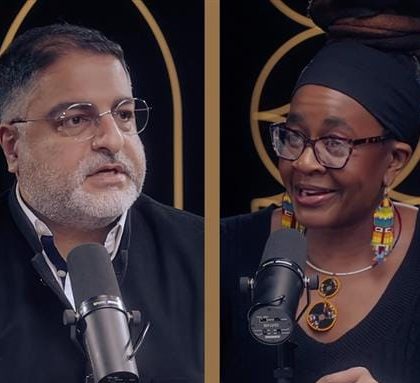
Zeid [00:00:00] A warm welcome to our distinguished audience here at the 2025 annual Doha Forum. I am Zeid Ra’ad Al-Hussein, the president of the International Peace Institute, and it’s my great honor and privilege to be interviewing Dr. Rob Malley today. Rob is one of America’s most experienced diplomats and negotiators. A former head of the International Crisis Group. He has served three different administrations and he’s recently written a marvelous book, Tomorrow is Yesterday, Life, Death and the Pursuit of Peace in Israel, Palestine. And it’s really beautifully written, Rob. Powerful in both opinion and introspection. For the most part, I’d want to focus on the contents of the book. And in particular on the machinery of negotiation. And if we have time, then also ask you a few questions about JCPOA or the Iran nuclear deal. Rob, first of all, give us a short summary of what led you to write the book together with your co-author, Dr. Hussein Agha.
Rob Malley [00:01:21] You know, there are many reasons why one writes a book. I think in this case, one of the things that really struck both Hussein and I is how much, particularly after October 7th, we were hearing the same orthodoxy, the same tired phrases, and some of the real myths about… Quote unquote peace process and for example the notion that what happened on october 7th was sort of an anomaly came out of nowhere or That israel’s reaction was also an aberration and came out of nowhere whereas in fact our view is that both what happened in october seventh and The horrendous war that followed were reflections expressions of deep social forces, which is why october 7th, was widely welcomed by many Palestinians, both Palestinians at the time, and why the war that followed and the atrocities that were committed afterwards, which most people today, or most legal scholars call a genocide, was also welcomed and applauded by the Israeli public. And if you don’t understand that, you’re missing basically what the conflict is about. And we wanted to write something that would sort of look back at why everything that had been tried had failed, what had been misdiagnosed, and where we go from here.
Zeid [00:02:35] So the book, I assume, is aimed at, or the target audience for the most part, is the American public, is that right? Or were you also thinking of an Arab public and a Palestinian and Israeli public as well?
Rob Malley [00:02:51] Anyone who, anyone who can read. Or anyone.
Zeid [00:02:54] So if we move to your first major part of this, which was the Tempt David II negotiations and then the lead up to it, in the book, you make the argument that it wasn’t a real negotiation as such, or you could say that the US delegation of which you were a part wasn’t really mediating. Could you give us just, in your opinion, what… Would represent a traditional mediation or negotiation. And how was Camp David II then different?
Rob Malley [00:03:31] Maybe the easiest way is to compare Camp David 1 to Camp David 2. So President Carter, at Camp David one, the Americans came with a paper to negotiate between the Israelis and the Egyptians, and went back and forth but the Americans kept the pen. And they took amendments by one, amendments by the other, and ultimately they came up with something that both sides grudgingly would accept. Camp David 2 is different. And Camp David was different for many reasons, which we could go back to having to do with America’s history, its relationship towards the Israeli-Palestinian conflict, the status, the asymmetric status between Israelis and Palestinians. And also, frankly, the fact that the American team at the time was much more familiar with one narrative. As opposed to the other and the some of them were were known biases. Some of them I think were unconscious biases But what happened there basically was after a first futile effort to put a paper on the table Which was rejected by prime minister barak and also by by chairman arafat But I think in fairness barak’s rejection was much more important to american eyes than arafats rejection I think at that point it became a free-for-all where the americans ended up taking israeli ideas Presenting them to the Palestinians the Palestinians rejected them. They went back to the Israelis They asked for more ideas and and the US became reduced almost to the role of messenger Which is quite extraordinary when you think of all the power of the US had the leverage it had that that’s the role it played Which is why we say it wasn’t really a negotiation. It was a negotiation within the Israeli team It was in a negotiation with in the American team, but it wasn’t a negotiation between Israelis and Palestinians It was presentation of constantly changing proposals based on Israel’s estimate what the Palestinians couldn’t say no to an estimate that proved wrong time and time again
Zeid [00:05:15] And you speak, or you write in your book, of the steadfastness of the Palestinian position in the sense that they were not going to surrender a principle to whatever idea was making its way with such regularity. You spoke of a blizzard of ideas being transmitted to the Palestinian side. In Arabic, we often speak in negotiating terms of this idea, Take what you can. And then in the detail you can ask for more. It seems that the Palestinian negotiation wasn’t in that frame of mind or were they in that framework of mind, but they just couldn’t come to grasp with what the actual Israeli position was because it was changing so often.
Rob Malley [00:06:02] So I’m not here to write a brief for the Palestinians. I think if you read the book, you’ll see we’re also critical of the Palestinians’ position. But I think to summarize what went wrong at Camp David, and for some reason it always comes back up because people want to use the failure of Camp David to demonize the Palestinian National Movement and to blame them for the failure and for even where we are today. And that’s why I think it’s important to go back and understand what went wrong. But at the end of the of the negotiations one of the smartest members of the american team a lawyer Turned to us as we were doing the post-mortem and he said the problem with this negotiation with us americans Is we didn’t take the issues seriously enough. We treated them sort of as oh right of refugees Let’s figure out some way of dealing with it. Even if we’re not going to deal with the substance Territory will just find a line on a map and just divide it and and that would be it but to your point about trying to understand why the Palestinians reacted the way we did. And again, I’m not here to justify it. But I think from their perspective, what did they see? They saw proposals, as you say, that changed constantly, which reflected, again, the Israeli’s conception of what they could get away with and get a deal. And there was never a map. There was never, and I see in the room some people who were at Camp David, there was never a map. There was ever anything concrete. It was maybe if those ideas were orally conveyed. I think the Palestinian perception was, if we agree to this, we give up our constant, the principles on which we have based our movement and which we’ve already compromised on, which is we need a state on the borders of 67. We need the rights of the refugees to be defended. We need to have a capital in East Jerusalem. And what we’re going to get in, and we need to have a sovereign state, what we are going to get in exchange are very amorphous abstract principles that say, for example, the Palestinians will have sovereignty over 91% of the West Bank. They don’t know what percentage. Why 91%? Why wouldn’t they get 100%? The trade was going to be 91%. In exchange, you would get 1% of Israel proper as a swap. I mean, not of Israel property, but the equivalent of 1%. So ultimately, they would have lost about 9% of of the west bank. But without a map, without any numbers on refugees returned. So I think the feeling was, we’re going to give up our constants in exchange. We’re going to get a document. That doesn’t really tell us what our future is going to be and they thought it was a trap I think arafat was convinced this was a track where he was going to have to give up The principles on which the palestinian cause at that point were founded in exchange for very abstract changeable malleable Concepts which were delivered by two parties which were in cahoots with each other and which would then determine How these abstract principles would be translated in practice So again the other things the palaces might have done to be in a stronger position But I think it’s important to put them yourself in their shoes and as a mediator, I think we failed to do that
Zeid [00:08:52] Rob, at the time I was an ambassador at the UN and constantly in and out of the security council. Why was there no inclusion of Egypt and Jordan as part of the whole discussion? I mean, after all, at the Y accords, Egypt and jordan were there. Why were they left out of Camp David II?
Rob Malley [00:09:13] Again, we go into it in the book. I think one of the preconceptions or the assumptions of this process was that it needed to be an american-led process And the exclusion of others unless the americans thought it was useful for them or the israelis felt it was Useful for them. And so as you i’m sure you recall at the tail end of camp david When it was clear that the summit was going to fail. That’s when president clinton picked up the phone and called king of Saudi Arabia, the king of Jordan, the president of Egypt, and said we need your help to support a proposal upon which you haven’t even been briefed, to put pressure on Arafat to accept it. The notion was if the Arabs are there, it’s going to tilt the playing field, it’s gonna help the Palestinians, and so let’s keep it in a tet-a-tet or a three-way between the U.S., Israel, and the Palestinians. Again, unless you needed Arabs to come in at particular moments. Again, I think. That’s one of the lessons what I have to learn from it. You cannot resolve, you cannot think of the Palestinian issue abstracting it from broader Arab question. And let’s not forget this was born as an Arab-Israeli conflict, not as a Israeli-Palestinian conflict.
Zeid [00:10:18] Could you also just wind back and touch on the Oslo peace process itself? You are critical of it, of course. What was good about it and what was its main deficiency?
Rob Malley [00:10:32] It is the first agreement between the Israelis and Palestinians. So to that extent, it’s a very important historic breakthrough. And without it, you wouldn’t have had a conversation between the two and the process that followed. I think the main flaw is that it is based on a basic misunderstanding about what the two parties were agreeing. I think from an Israeli perspective, they were the generous party that agreed to recognize the PLO as a representative of the Palestinian people. They didn’t accept the notion that it would be a Palestinian state, but in exchange for that recognition, they assumed that the Palestinians would provide security for them on whatever territory that the Palestinian, ultimately the Palestinian authority would be established on. So it was a deal in which we recognize you as sort of an entity that is representative and in exchange you have to provide us with security. Now the scene of concept was. We are recognizing Israel, which was, you know, that was a major concession for the Palestinians. For them, it was sort of the recognizing the state of Israel, accepting Israel in the borders of 67 in exchange for which they thought they were going to get a sovereign Palestinian state. Now, also didn’t say anything about all of this. It really was just a trade of recognizing Israel and its right to live in peace and security against recognition of the PLO as the legitimate representative of the Palestinian people. It didn’t say these were all unsaid parts of the deal, but I think there was a fundamental misunderstanding. There never was a definition of the end goal. And therefore, each side could pursue its policy, assuming that its goal would be realized. And of course, the asymmetry of power meant that one side could achieve its goals while the other wouldn’t.
Zeid [00:12:05] And to me, it always seemed that the idea, as you just cast it, was almost half-baked. But within it, there was enough momentum generated that it was launched almost prematurely. It’s almost like someone who is a runner, who has worn out shoes, gets a new pair of shoes, puts one on and starts running with the other foot still barefoot. Because the impression given was that it obscured what else was possible. And you’ve sort of touched upon this toward the end of the book. You said that there are all these creative ideas that are out there. But once we were stuck in Oslo, we were stuck in a sort of rail, on a rail which obscured from our view what other possibilities potentially could have existed. And so we’ve potentially lost 30 years as a result of it.
Rob Malley [00:12:58] Not only have we lost 30 years, but compare where we were, it’s really the saddest thing, and I don’t want to leave people with this depressing note, but where we were 30 years ago compared to where we are today on almost every metric, things are worse. And this was true even before October 7th, let alone after October 7. So to say that the Oslo process ended up, or the peace process, whatever one wants to call it, as a failure, that should be completely uncontentious. I think what we need to reflect upon is why it went wrong. As we say, part of it was based on. The fact that both sides were speaking different language and that the asymmetry of power was never addressed and the end goal was never specified. As you say, they were launched on this race without knowing where they were gonna go. And so each side goes in its own direction. And meanwhile, the facts on the ground are moving in one direction as opposed to another. And yes, I think the premise of those 30 years and beyond was of hard partition between the state of Palestine, state of Israel. On=e of the themes of the book is whether that was ever realistic. It certainly is not realistic today, in our view, the notion that you’re going to have hard separation and the notions that were discussed, whether at Camp David or afterwards. Those, given the realities on the ground, 700,000 Jewish settlers in the West Bank and Jerusalem, billions of Palestinian refugees who don’t have rights. That is not going to be that you cannot fit the aspirations, the fears and the anxieties of both sides within the confines of a strict rigid partition between two sides. So we need to open our eyes to different different conceptions of sovereignty, different conceptations of coexistence between Israelis and Palestinians. And those have been just as you said earlier, why were the Arabs kept out? That was sort of one of the straight jackets of the peace process. The other was that there was a model that was assumed. That wasn’t going to happen. And part of the real harms that they also process is that because there was this goal, which the entire world endorsed and applauded, but because it was never going to be achieved, it served as cover for the perpetuation and aggravation of the status quo. So that is why 30 years of chanting two-state solution ends up with a situation as farther away from a two-states solution than we’ve probably ever been.
Zeid [00:15:06] And certainly from an Arab point of view, I mean, the constant settlement building and settlement activities. I mean just, it was constant stream of poison running into the system. Made it hard to believe that there was any genuineness in terms of, and you spoke, look, there were mistakes probably made on the Arab side as well. And certainly, from Palestinian side, everyone make mistakes. But it was the consistency with which the settlement policy. You know, found expression that made it very difficult from the Arab side.
Rob Malley [00:15:37] And that’s not a mistake, right? I mean, that’s a feature, that not a bug. And again, I think one of the lessons, and it applies very much today, people could be critical of Israel’s policies and some people would say that they don’t make sense even from Israel’s long-term point of view, but there’s nothing more rational than the policy that Israel has pursued. If there’s no cost to pursuing a policy that enables them to continue the settlement expansion, enables them encroach on Palestinian life. Why shouldn’t they do it? Why wouldn’t they? Negotiations ultimately about cause-benefit and one thing President Obama told us at the end of his presidency was the irrational Part is to think that Israel would change its course if there’s no pressure on Israel to do so It’s not irrational for Israel to continue on its path. That’s the most logical thing it would do So yes settlement construction was Never addressed that in the Oslo Accords. Why wouldn’t Israel continue?
You’re listening to The Negotiators. On each episode we look at one dramatic negotiation — through the lens of one of the participants. More after the break.
BREAK!
Zeid [00:16:34] I’d like to take you to this initiative, a land for all, two states, one homeland. Because it’s not envisaged, at least by the grassroots movement of Israelis and Palestinians who’ve constructed it, that there would be any swaps or any adjustment of the line, the 4th of June, 1967 line. This, I think, is quite clever because no matter what happens in the near term, much of it would be rejected. All of it will be rejected by much of the world. If there is settlement building, it sort of doesn’t compromise that vision because ultimately all of it would have to be back under direct Palestinian state of Palestine’s control. And that’s quite clever, isn’t it? I mean, that way of seeing two states in one homeland, two states. Where you don’t have a swaps negotiation, where you grant permanent residency to the settlers on the West Bank, they would be permanent residents of the state of Palestine. The Arab Israelis will choose to either remain as Israelis or become Palestinian citizens permanent residents in Israel. There’s a symmetry there. There’s pathway for all refugees to find a way either to Palestine as citizens of Palestine or to Israel. As permanent presidents in Israel. And then you have freedom of movement, which is essential. And you have certain institutions in a Confederate arrangement. That makes sense to me. Does it make sense to you?
Rob Malley [00:18:12] So rather than focus on, and yes, I think that there are many ideas out there, that’s one of them, that are creative, that help break that straight jacket. I think, again, it goes to the fundamental theme of the book of misdiagnostic, the nature of this conflict. This is not a conflict about let’s just draw a line on a map and call it quits, which is often how the Americans looked at it. That’s a very quixotic American view of every problem has a technical solution and we’re just going to be, you know, logical and draw a map and divide the West Bank and divide Jerusalem. This is a conflict that is about emotions, and psychology, and history. And, you know, the Palestinians, they weren’t fighting, and they’ve been fighting for a long time for a state on the borders of 67. That’s not been the fight. Otherwise, why were they fighting between 1948 and 1967? And for many Israeli Zionist Jews, their attachment is to all of the land, and it’s a sort of an emotional attachment and the notion of giving up anything. And many of them would tell you, hey, Braun is much more important to us than Tel Aviv. That’s where, and that’s our religious history. So the whole notion of division and partition is one that is kind of alien to the people, the indigenous people. And so ideas that are out there that recognize. The full attachment of Jewish people to all of the land, Palestinian people to the land and then try to find ways that allow, that are not going to force people to move again. I think we mentioned ideas like Land for All, but we mentioned other ideas that are out there that we, Hussein and I, don’t come up with Blueprint. This is not a policy report, this is not something that is designed for policymakers to say, oh, here’s what we’re going to do. Houston and I were associated with 30 years of failure, we’re not going to now come and say, listen to us, we now have the right solution, and now you have every reason to trust us. What we’re saying is people have to be more creative, more courageous, more imaginative, not us, but Israelis and Palestinians and others are going to help them because the ways of the past have failed. And I know how difficult it is to give up on the ways to the past because they’ve been part. Of orthodoxy and of the familiar, and it’s hard to break with the familiar. But the familiar and the orthodox is what got us where we are today.
Zeid [00:20:19] I have to say, the end of the book, it was a bomb. It was a tonic, because some of the chapters in the middle were hard going, essential reading, beautifully written. But you were reminding us of something that was painful, I think, for everyone who was close to the process. You yourself served in three administrations. Your despair was evident. Why did you keep going back, Raoul? Was it because you were… In dialog, so to speak, almost with your father still. And perhaps you can mention your father’s view, but you wanted to show your father that there is a space where sometimes even the impossible can find expression and find realization. Why did you keep going back?
Rob Malley [00:21:11] Nobody had warned me that this would be a psychoanalytical session Um, I don’t know. I kept so I won’t go on about my father, but you’ll you’ll read about it in the book He was a egyptian jewish arab nationalist very Iconic classic in that sense who was always an outsider everywhere He went and so the notion of my going into not just one but three administrations in a country whose policies he completely rejected. That was a little bit ironic, and I don’t know, there’s another Freudian dimension there. But there is, I mean, there is an addiction, just as I said, there’s an addiction to the familiar, there’s a addiction to orthodoxy. There is an addition to being in positions of power that I’m sure many people either in this room share or understand. And it can be quite appealing, attractive to feel you’re in the room where you can make a difference. At the end of the day, you have to ask yourself how much of a difference one made and what were the compromises that were. Required by that life choice. I did go back, maybe wrongly, particularly the last chapter, which you said we might evoke, which was the trying to revive the JCPOA under President Biden. But I think one always has the hope that you could change things and make things just a little bit better. Again, as I say, I think everyone owes to given introspection to think, did you really make that difference?
Zeid [00:22:31] So now that you mention it, tell us about President Biden’s view with respect to JCPOA. In the book, you contrast his commitment, or perhaps lack of, with President Obama’s. Could you give some sort of favor and expression to that?
Rob Malley [00:22:48] Yeah, so I know this is sort of a forum where we talk about negotiations and mediation. I think it’s a really interesting contrast between President Obama’s approach to the Iran negotiations and President Biden’s, but also to the Israeli-Palestinian talks. For me, one of the most satisfying moments, even though it’s controversial, of my career was the negotiations for the JCPOA because there I saw how a U.S. President who really believed that something was the national core national interest was prepared to take on not just critics. In israel not just critics in the gulf and not just critiques at home critics in congress from his own party And he believed that it was so important for the u.s To avoid what he considered this possibility of either is iran getting a bomb or the u,s Feeling compelled to bomb iran that he was prepared to take all those risks to reach a deal That was never the case in israeli-palestine talks the us never felt that this was such a strategic importance to get israel Palestine peace that we were prepared or that any president i served was prepared to go against domestic forces, regional forces. You know, having the process alive was good enough. And to President Biden, and there I think another lesson is, A, President Biden for him, this was not an absolute priority. One could agree or disagree. He just didn’t think that this was among his top issues. If he could get a deal, why not? If he couldn’t, you know, he felt that you could manage the problem. I think that was also true, by the way, of the Iranian side in the second iteration. I think back under President Obama, I think President Rouhani felt that getting a deal was also a critical national interest for Iran. And I think the Supreme Leader went along. I think in the next iteration, neither the Supreme leader nor the American president felt that this was an absolute priority. Both of them felt that they could live with alternatives. And in that situation, I probably should have known it before accepting the job. It was very hard to get a deal with all the degree of mistrust, the mistiming, and the mishandling of the negotiations. It was a hard sell to begin with because of the politics on both sides. With neither leader personally committed to it, it was simply not going to happen.
Zeid [00:24:50] And we have since gone through a 12-day war. The Iranian nuclear infrastructure was attacked. The Supreme Leader is himself quite old. If you were to offer advice, what would it be in terms of, at what point would an engagement make sense, and when should it begin between the US and Iran?
Rob Malley [00:25:17] I mean, engagement is ongoing, I suspect. I think Steve Woodcoff and his Iranian foreign minister are probably exchanging WhatsApp messages. So the issue is not engagement. I think engagement is almost always smarter than non-engaging. The question is, what are they engaging about? And I think one of the lessons, again, I was a firm believer in the JCPOA. I think, one of lessons of what’s happened since is it’s hard to imagine the deal between Iran and the United States. It’s not gonna have to touch upon other regional security issues. A, because you have this X factor, Israel, which is not going to be satisfied by a purely nuclear deal. But also, I think both Iran and the US have discovered over the past period that these issues are interconnected. It doesn’t mean the JCPOA couldn’t have succeeded, but particularly where we are today, I we’re going to have to revise even the parameters of the negotiations and find a way to deal with a broader spectrum of things. And President Trump, you have somebody. Not my politics, not my kind of vision of the world, but who has that capacity, perhaps, to break with orthodoxies, sometimes for the better, often for the worse. But in this case, he may be prepared to put on the table with Iran. Things that his predecessors were not in terms of lifting certain forms of sanctions. And in exchange, maybe the Iranians would be prepared to discuss issues that they’ve been very reticent to discuss in the past. So I’m not saying we’re there now. If I had to make a prediction, I think where we are, we’re going to live with this very unstable status quo, with the risk that Israel at some point may decide that it could take out more of Iran’s missile or nuclear infrastructure. So I don’t think we’re on the verge of a major breakthrough between Iran and the U.S. But in the future, when that would happen, I think it would be smart to rethink sort of the confines of the negotiations and open them up to more issues.
Zeid [00:27:03] The Obama administration, I was Jordan’s Sherpa on nuclear security. And one of the concerns we had was even small amounts of enriched uranium pose security establishments around the world, enormous headaches. The 440 kilograms is something to worry about. If it is indeed and potentially dispersed, it’s something that the international community needs to worry Bye. Isn’t that a, sort of a galvanizing force?
Rob Malley [00:27:36] Sure. I mean, yes. But at the same time, and I may be proving wrong any day now, so don’t quote me, but the notion that Iran under the current conditions is going to resume an enrichment and nuclear program when they know that they’ve been so thoroughly penetrated. One of the lessons of the 12 day war is the degree to which Iran’s security had been breached. And so the notion they’re going to restart that now. That’s why I say, I think that could live with this very unstable status quo. Not my preference, but you could, because I think it’s pretty unlikely that Iran is going to take a provocative step, knowing, A, that they would be discovered and knowing, B, what the response would be at a time when they probably can’t truly defend themselves against something that was evident in the 12 day war. So I would assume that Iran would hunker down and wait for a better time unless there’s some negotiations with the U.S. That leads to a breakthrough. So, yes, the 400 kilograms are clearly a longer term issue that needs to be dealt with. I just don’t see that it’s something that tomorrow Iran is going to try to do something provocative with. Again, maybe I’ll be proven wrong. It wouldn’t be the first time.
CREDITS (DD then FP)




Peace & Conflict
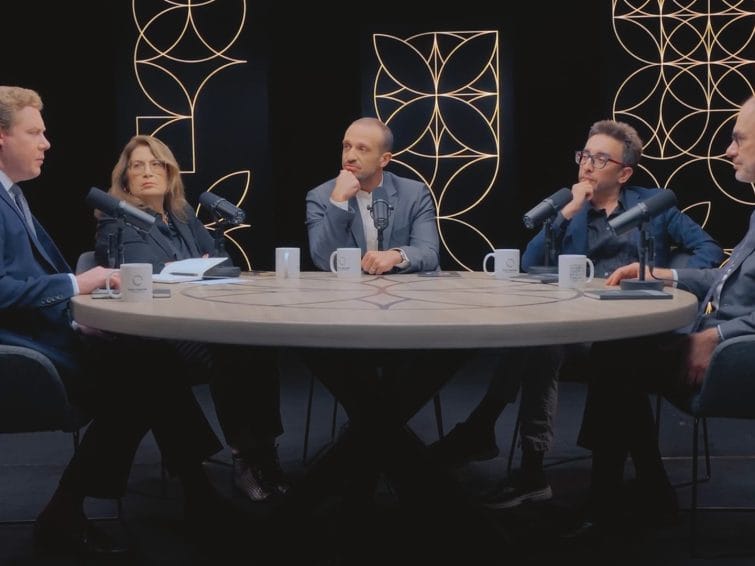
After Gaza, who sets the rules of global justice?
Doha Debates Podcast
S2
E3
133 MINS



Our other podcasts
Doha Debates Podcast
Doha Debates Podcast brings together people with starkly different opinions for an in-depth, human conversation that tries to find common ground.

Lana
A podcast in Arabic for today’s generation to discuss their outlook on the world, hosted by Rawaa Augé.